
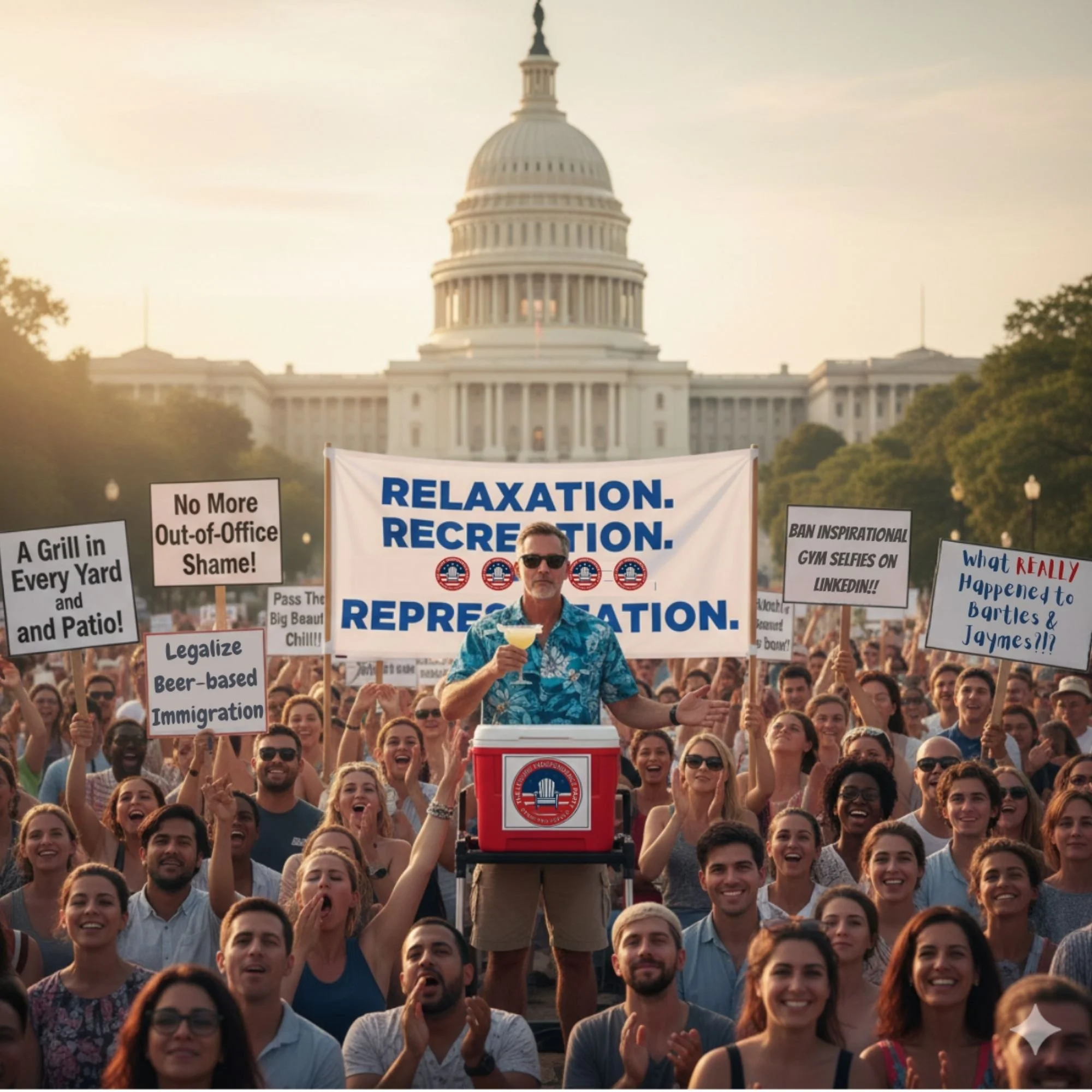
We’re Not Right. We’re Not Left. We’re Not Even Standing.
A movement for those who believe leisure is a constitutional and human right.
“I’ve never stood for anything in my life. And thanks to the Leisure Independence Party, I still don’t have to.”
WHO WE ARE
The Leisure Independence Party represents people who are tired, not just politically, but physically and socially. We stand for reasonable schedules, fewer unnecessary demands, and the view that disconnection should not be accompanied by feelings of shame or guilt.
While other parties argue about space lasers, U.N. escalators that suddenly became stairs, and reusable-straw mandates, the Leisure Independence Party recognizes the true drivers of national prosperity: a stocked cooler, guilt-free vacations, and the right to a long Sunday brunch unthreatened by an 8 a.m. meeting on Monday.
Our platform is simple. Every citizen deserves access to a grill, to genuine time off, to fewer political arguments at dinner tables, and to happy hours that are actually happy and not fueled by despair.
We believe health care matters, but so do sun care, pool care, and hair care.
We affirm every citizen’s right to leisurewear appropriate to climate and mood, including aloha shirts, cargo shorts, rompers, bathrobes, yoga pants and muumuus. The Party remains grateful to Helen Roper.
We reject the marketing fiction of “Career Wear,” a category invented to suggest that ladies’ polyester pantsuits and blouses require a LinkedIn profile and that clothing must signal productivity to be legitimate. The Career Wear Industrial Complex must be dismantled.
The Party invites all who are exhausted by conflict, outrage, career wear expectations, and the shrinking availability of personal time and simple enjoyment to join us. We support a world where not every preference becomes a position, including the choice to order water with or without ice, where brunch can be enjoyed without fear of Monday consequences, and where enjoying life and wearing comfortable clothing without judgment before a retirement that may never come are recognized as markers of a balanced society.
Leisure is not excess. It is the quiet foundation of a society built around enjoyment.
OUR INITIATIVES
The following initiatives outline the Leisure Independence Party’s position on work-life balance, burnout prevention, accessible relaxation, slow living, grilling equity, social reciprocity, modern digital conduct, and the preservation of sufficient enjoyment for all citizens.
No Backyard Left Behind
The No Backyard Left Behind Act addresses grill equality, outdoor gathering, and the equitable distribution of communal leisure infrastructure.
The Leisure Independence Party recognizes that millions of citizens continue to experience Grill Inequality. Outdoor cooking is hereby affirmed as an essential expression of leisure and a widely accepted path to social cohesion.
The No Backyard Left Behind Act supports broad access to grills, smokers, kamados and any device capable of transforming raw ingredients into positive social experience via federal purchase subsidies.
Participation shall not be limited by residency type. Condominiums, apartments, and other backyard-adjacent living arrangements shall be accommodated to the fullest extent possible.
Units equipped with balconies, windows, fans, or a general willingness to make it work shall be considered compliant under this Act.
The Party affirms that no citizen should be excluded from the communal benefits of grilling due to cost, zoning, square footage, or landlord enthusiasm.
The Big Beautiful Chill
The Big Beautiful Chill addresses hustle culture, workplace burnout, and the institutionalization of constant urgency in modern professional life.
The Leisure Independence Party recognizes that modern life has adopted an unsustainable tempo. Calendars are saturated. Notifications imply emergency. The managerial phrase “quick sync” rarely proves accurate.
The Big Beautiful Chill establishes a national posture of intentional slowness and appropriate calm.
Under the provisions of “The Chill,” meetings, whether virtual or physical, shall not occur within sixty minutes of a prior meeting. No communication shall be presumed urgent solely by virtue of being sent.
Organizations are encouraged to reduce manufactured urgency, discourage performative overwork, and refrain from the habitual use of motivational corporate phrases that amplify ordinary tasks into heroic endeavors, including but not limited to: “crush it,” “thought leadership,” “results-driven,” “leaning in,” “fast-paced culture,” and “rockstar mindset.”
Calendars shall contain visible margins. Responses may arrive tomorrow. Silence shall not be interpreted as disengagement.
The Party affirms that fewer meetings, slower replies, and lower blood pressure are not signs of decline, but evidence of a civilization operating at an appropriate pace.
Entry Negotiated Through Engagement & Reciprocity (E.n.t.e.r. )
The E.N.T.E.R. Act addresses the movement of individuals into shared civic space through the lens of contribution, reciprocity, and responsible participation.
The Party recognizes that entry, whether into a nation, a neighborhood, or a backyard gathering, is strengthened by engagement rather than entitlement.
The Leisure Independence Party maintains an open and practical approach to entry grounded in mutual responsibility. Contribution signals intent. Reciprocity signals commitment.
Under the provisions of the E.N.T.E.R. Act, individuals seeking entry may be granted provisional residency upon arrival with a recognized contribution in hand, preferably one reflective of their place of origin and offered in good faith. A well-selected regional beer, a properly sourced spirit, or a dish carrying actual meaning shall be regarded as an act of cultural diplomacy.
Accompanying documentation may include a verified rideshare rating of 4.85 or higher and a demonstrated history of returning the shopping cart to its proper location - widely accepted indicators of decency and respect.
Recognized contributions shall include, but are not limited to:
• A six-pack maintained at appropriate temperature and selected with discernment
• A top-shelf spirit representative of actual heritage
• A dip capable of retaining structural and visual integrity for no fewer than ten minutes
• Charcoal, propane, or comparable fuel
• A Bluetooth speaker with acceptable bass range
• A playlist containing at least one Hall & Oates deep cut
Pathways to permanent status may include demonstrated excellence in playlist management, consistent contribution to communal preparation of food and beverage, the instinct to replenish ice before it is fully depleted, and voluntary participation in the orderly restoration of shared space before departure.
Those who arrive without contribution, request the Wi-Fi password prior to greeting the host, initiate unsolicited debates on religion or politics, or offer grill instruction without jurisdiction, including but not limited to the phrase “I’d go higher heat,” may be required to return home for a period of reflection and re-evaluation of their contribution to society.
The Party affirms that the door remains open. Distinction is welcomed. Engagement is expected. Reciprocity is required.
Social Conduct Regulation & Oversight for Leisure and Life Act (S.C.R.O.L.L.)
The S.C.R.O.L.L. Act addresses influencer culture, excessive documentation, and the performative broadcasting of everyday life in digital environments.
The Leisure Independence Party recognizes that modern citizens are increasingly unable to experience events, opinions, or meals without simultaneously documenting, narrating, or broadcasting them.
Covered behaviors include, but are not limited to:
The conversion of ordinary experiences into public lessons or guidance, such as the posting of shirtless selfies from a gym restroom on sites such as LinkedIn accompanied by hashtags such as “#Discipline,” or “#Leadership Journey.”
The filming of concerts, dinners, and sunsets for assumed audiences.
The publication of political opinions and personal viewpoints expressed primarily for visibility rather than effect.
The casual adoption of influencer posture in situations that do not require influence.
The Party affirms that not every moment requires a post, not every thought requires an audience, and not every experience improves through documentation.
We advocate for a society that looks up, remains present, and accepts that some things are better remembered than uploaded.
Recreational Equity & Scheduled Time (R.E.S.T.)
The R.E.S.T. Act addresses workplace burnout, time-off transparency, and the cultural pressure that discourages employees from using their vacation days.
The Leisure Independence Party recognizes that American workers are technically granted vacation days but are not always granted cultural permission to use them. Vacation has increasingly been repositioned as a productivity enhancement tool that must demonstrate quarterly impact, rather than a period of actual rest.
The R.E.S.T. Act establishes national standards for time-off transparency by requiring employers to publish both their written policies and their demonstrated practices.
Under the provisions of R.E.S.T., policies described as “unlimited vacation” shall be accompanied by a clarification of expectations. Such policies must disclose the average number of days actually taken by employees and whether managerial behavior materially supports their use.
Employers shall publish an annual Time-Off Utilization Index, reporting days requested, approved, deferred, and quietly discouraged. The Index shall also document barriers to usage, including cultural pressure, managerial hesitation, or remarks such as, “Sure, if you really think now’s the right time,” and “Must be nice.”
All job postings shall include a PTO Expectation Disclosure outlining the number of days considered standard, the average utilization rate among current staff, and whether time off is operationally supported or functionally symbolic.
The Party affirms that rest is not a performance metric. It is a condition.
Civic Oversight Of Leisure Escalation & Recreation (c.o.o.l.e.r. )
The C.O.O.L.E.R. Act addresses leisure inflation, over-optimization, rising costs, and the steady escalation of ordinary experiences into premium obligations.
The Leisure Independence Party recognizes that a number of once-simple pleasures have recently been upgraded past the point of necessity. Ordinary outings now require strategic planning and casual hobbies arrive bundled with professional expectations.
The C.O.O.L.E.R. Act affirms that leisure is not a premium tier.
Commerce remains welcome; quality deserves compensation, and innovation may proceed without interference. The Party shops, pays, and tips appropriately.
However, when participation in a backyard pastime requires a starter kit priced like professional equipment, or when a public sunset is treated as a pay-per-view event, the calibration may be slightly off.
Under C.O.O.L.E.R., the Party distinguishes between excellence and escalation. Premium experiences may exist. What may not quietly disappear is the sufficient.
A picnic shall not require advance booking, curated vendor packages, or a recommended aesthetic.
A standard library card shall not be replaced by a subscription tier promising “priority browsing.”
A public beach shall not introduce surge pricing based on sunset conditions.
A municipal park shall not require a QR code, dynamic pricing, or “enhanced grass experience” upgrade.
A routine drive-thru combo meal shall not necessitate comparison shopping or app download.
The Act encourages businesses to maintain entry points for citizens who would simply like to attend, participate, sit down, eat, or enjoy themselves without first optimizing.
There is no objection to a higher tier. There is an objection to the elimination of the first one.
The Party affirms that aspiration may scale upward, but enjoyment must remain broadly available.
Leisure for All is not leisure for some.
Otium Pro Populo remains in effect.
Sweet Freedom Initiative (S.F.I.)
The Sweet Freedom Initiative addresses civic participation, public singability, and the inclusive performance of national identity.
The Leisure Independence Party recognizes that the current national anthem presents measurable performance challenges for the general public. Its melodic range exceeds the comfort level of most citizens and has resulted in catastrophic failures across Little League fields, municipal ceremonies, and professional sporting events.
The Sweet Freedom Initiative proposes the formal adoption of Michael McDonald’s “Sweet Freedom” as an official supplemental anthem for designated leisure observances. The Party observes that the song’s lyrical embrace of liberation, uplift, and collective momentum reflects a spirit more readily embraced by everyday participants of civic life, making it resonant with the ideals of engaged citizenship.
With its steady tempo, attainable vocal range, and thematic focus on optimism and mutual participation, “Sweet Freedom” enables confident performance by citizens of varying lung capacity, musical training, age, and recent beverage intake. The Initiative regards singability and shared understanding as matters of civic inclusion.
Under S.F.I., the celebration of freedom shall no longer hinge on upper-register heroics.
From ballparks to backyard gatherings, “Sweet Freedom” shall serve as the anthem of a nation capable of singing together without anxiety, vocal improvisation, or public apology.
The Party affirms that liberty sounds better when it can be reached by all who stand to sing.
Official MEMBERSHIP
The Leisure Independence Party is sustained by citizens who value proportion, hospitality, accessible leisure, and the preservation of the sufficient.
Those aligned with these standards may apply for official membership.
Otium Pro Populo.
Recreational Endurance and Deployment Yield (R.E.A.D.Y.)
The R.E.A.D.Y. Act addresses functional capacity, load carriage readiness, terrain mobility, and the equitable distribution of effort in shared leisure settings.
The Leisure Independence Party hereby establishes the R.E.A.D.Y. Act to preserve baseline physical competence in the execution of leisure.
The Act recognizes that beaches, parks, patios, and campsites require measurable capability in transport, stabilization, and terrain navigation. Without such capability, leisure readiness becomes delayed, strained, or reassigned to the most conditioned attendee.
Accordingly, the following National Recreational Readiness Standards are adopted:
Folding Chair Conveyance Standard
Citizens shall transport one folding chair a minimum of 25 yards without pause or negotiation.Cooler Load Transfer Requirement
Citizens shall relocate one standard cooler from vehicle to site across uneven terrain without visible distress.Umbrella Anchoring Protocol
Citizens shall plant and secure one beach umbrella against moderate wind without unintended aerial deployment or subsequent recovery by adjacent parties.Low Chair Recovery Standard
Citizens shall sit and rise from a low recreational chair without assistance, rolling momentum, or audible regret.Soft Terrain Mobility Standard
Citizens shall traverse 50 yards of sand or grass without loss of forward momentum.Shade Deployment Competency
Pop-up canopy structures shall be deployed without escalation, prolonged consultation, or passive-aggressive commentary.
The R.E.A.D.Y. Act does not mandate aesthetics, personal bests, or competitive performance. It affirms only that citizens maintain sufficient functional capacity to execute leisure independently and without disproportionate reliance on the most conditioned participant present.